1. Defining the Brain Break: Beyond Simple Downtime
In the landscape of modern pedagogy, the “brain break” must be redefined from a mere lapse in instruction to a proactive neurological intervention. These intentional, short-duration activities are strategically designed to shift neural activity across disparate networks, thereby preserving the brain’s cognitive reserves. By facilitating a state of “relaxed alertness,” educators optimize the prefrontal cortex—the seat of higher-order executive function—ensuring students remain receptive to complex information rather than succumbing to the cognitive fatigue of an over-taxed neural architecture.
Effective brain breaks generally fall into three primary modalities:
- Movement-based: High-kinetic activities that increase heart rate and oxygenate the brain, stimulating the release of neurotrophic factors.
- Calming/Focused Attention: Practices designed to sharpen sensory receptors and regulate the autonomic nervous system, fostering sustained attention.
- Social/Creative: Unstructured or divergent tasks that leverage peer interaction and curiosity to stimulate “outside-the-box” neural circuitry.
To deploy these interventions with precision, educators must look beyond the classroom surface to the biological “whirring” that occurs when the brain is seemingly at rest.

2. The Science of the “Default Mode”: What Happens During Rest
Defending the use of “non-academic” time to skeptical stakeholders requires a firm grasp of the neurobiological mechanics of learning. As a Senior Neuroscientist, I maintain that cognitive downtime is not idle; it is a period of high-speed metabolic processing. Groundbreaking research by Mary Helen Immordino-Yang on the “Default Mode Network” (DMN) and Leonardo Cohen on “Neural Replay” proves that the brain uses rest to reconcile and imprint the day’s curriculum.
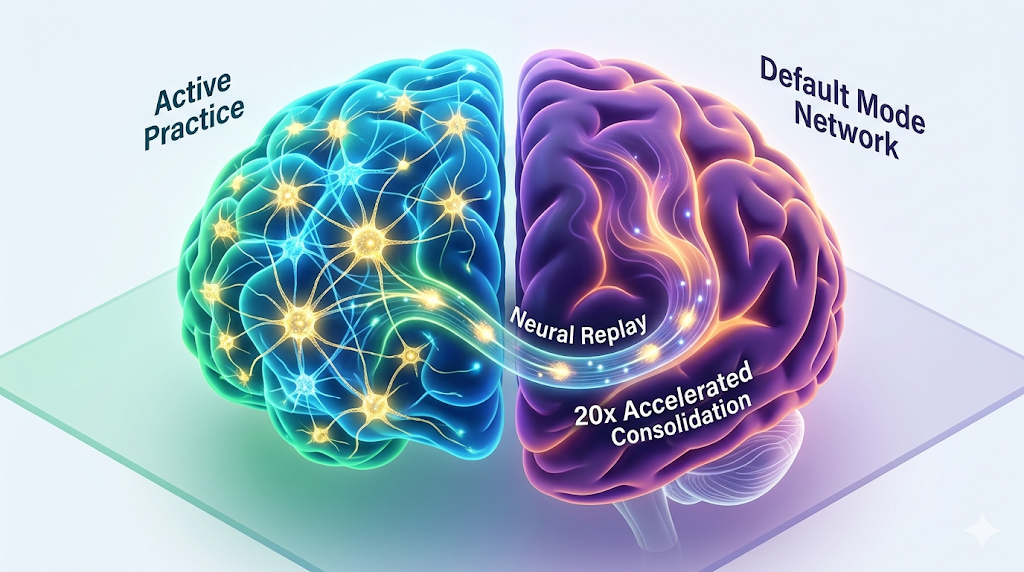
During these breaks, the brain’s information pathways undergo a virtual staging process. Cohen’s research identifies a phenomenon where the brain “compresses” behavioral sequences at a rate twenty times faster than real-time practice.
| Feature | Active Practice | Neural Replay (During Rest) |
| Brain State | Engagement with external stimuli and task execution. | “Default Mode”; focused on internal processing and reflection. |
| Processing Speed | Real-time (1x speed). | Accelerated (20x faster) than active practice. |
| Neural Mechanism | Sensory/motor processing in the neocortex. | “Binding” simple actions to complex skills via the hippocampus. |
| Outcome | Initial exposure and trial-and-error. | Memory consolidation and permanent storage. |
Crucially, these pauses serve as a “gatekeeper reset.” Dr. Judy Willis notes that stress and cognitive overload are the most detrimental disruptions to “traffic” along the brain’s information pathways. When students are fatigued, the amygdala—the brain’s emotional center—signals a state of overload, essentially shutting down the route to the hippocampus (the memory storage region). Brain breaks allow the amygdala to reset, reopening the path for the hippocampus to promote nerve cell growth and facilitate the “binding” of simple concepts into complex expertise.
3. The Developmental Imperative: Reclaiming Social Bonding in a Digital Age
Brain breaks are a strategic necessity for reclaiming human connection in an era where digital isolation is the default. Beyond mere “soft skills,” these social and unstructured pauses are essential for the development of Executive Functions, including working memory, self-regulation, and cognitive flexibility. These neural systems underpin all academic achievement; for a student to grasp new material, they must first manage the frustration and excitement inherent in the learning process.
The environment of the break also matters. While indoor games provide valuable cognitive shifts, Outdoor/Unstructured Play often results in superior “learning readiness.” Indoor environments frequently impose “indoor voice” requirements, which demand high levels of self-regulation and further deplete a student’s cognitive energy. Conversely, outdoor activity or “green breaks” allow these neural resources to “cool down.” By lowering self-regulation requirements, outdoor play restores the student’s capacity to focus when they return to the desk.

4. The “So What?” Layer: Quantifying the Impact on Learning
The implementation of brain breaks is a high-yield instructional strategy with measurable dividends. We cannot afford to view these as optional. A 2016 study on “Cognitive Fatigue” demonstrated that for every hour of instruction lacking a break, student performance dropped by 0.9% of a standard deviation. Over a school year, this is a cumulative loss equivalent to 10 days of school.
The quantifiable impact on student outcomes includes:
- Improved Focus: Research by Karrie Godwin reveals that elementary students spend upwards of 25% of class time distracted. Frequent breaks reset the “attention clock,” significantly lowering this distraction rate.
- Memory Consolidation: NIH studies on “wakeful rest” confirm that the brain uses downtime to bind memories together, a prerequisite for mastering new skills.
- Behavioral Regulation: Physical activity breaks have been shown to reduce disruptive behaviors by allowing students to expend pent-up energy, thereby increasing the effort they apply to subsequent tasks.
- Stress Reduction & Health: The American Psychological Association (APA) links regular breaks to the prevention of long-term health issues, including heart disease and depression, by mitigating classroom-induced anxiety.
- Working Memory Enhancement: A 2022 analysis suggests that even brief “green breaks” (10–90 minutes)—such as viewing a school garden or park—can measurably improve performance on tests of working memory and attention.
5. Implementation Strategy: A Tiered Library of Brain Breaks
To maintain a high state of “relaxed alertness,” educators must employ a diverse toolkit. Variety is the essential catalyst for sustained focus.
Level 1: Primary (Pre-K to Grade 5)
- Movement:
- Jitter Sticks: Action words written on popsicle sticks (e.g., “wiggle,” “hop”) to activate the motor cortex.
- Statue Freeze: A skip/hop activity where students must freeze in a specific pose (e.g., “lion”).
- 1-Minute Dance Party: A rapid kinetic reset to shift the classroom mood.
- Focus/Calming (Focused Attention Practices):
- Peeling a Tangerine: Students peel the fruit behind their backs. This sensory focus on texture and scent builds sustained attention and grounds the student in the present.
- Breathing Colors: Inhaling a “calm” color (green) and exhaling a “stress” color (red) to regulate emotions.
- Melting an Ice Cube: Holding an ice cube to observe it melting, used as a metaphor for letting worries dissolve.
- Pro-Tip: For younger learners, shorten the instructional block. Providing several 10-minute lessons with intervening breaks is vastly more effective than one 30-minute block.
Level 2: Secondary (Middle and High School)
- Creative:
- Think Outside the Box: Transforming a simple squiggle/doodle on a board into a complete drawing to spark divergent thinking.
- Wordle/Scattergories: Quick-fire word games that offer a mental pivot from heavy academic content.
- Social/Reflective:
- Walk and Talk: A “sanctioned” chatting period while walking. Providing this time intentionally significantly reduces unsanctioned talking during direct instruction.
- Journaling: Free-writing with calming background music to facilitate internal reflection.
- Guided Meditation: Brief mindfulness prompts to reset the amygdala before high-stakes assessments.
- Pro-Tip: Increase student agency by allowing older students to choose or lead the activity; when students have choice, neural engagement increases.
6. Best Practices: Timing, Frequency, and Routine
The efficacy of a brain break is determined by its timing. We must be proactive rather than reactive. A “reactive” break—waiting until students are rowdy or disengaged—is less effective because the amygdala has already signaled an overload, effectively “locking” the information pathways.
Neurologist Dr. Judy Willis recommends the following developmental timing intervals:
Elementary Students: 10–15 minutes of concentrated study / 3–5 minute break.
Middle and High School Students: 20–30 minutes of concentrated study / 3–5 minute break.
For maximum success, keep activities “short and sweet” (under 5 minutes) and utilize a visual timer to manage transitions. Consistency is the key to turning these moments into a routine that students’ brains can anticipate. Ultimately, depriving a student of these pauses is not an academic gain; it is a threat to the learning process itself.
——————————————————————————–
7. Resources and Further Reading
Continental Educational Publisher. “Recharge and Refocus: 16 Easy Brain Breaks for Middle School and High School.” Continental Blog, 7 Aug. 2024.
Desautels, Lori. “Activities That Prime the Brain for Learning.” Edutopia, George Lucas Educational Foundation, 15 Apr. 2019.
Edutopia. “60-Second Strategy: Jitter Sticks.” YouTube, uploaded by Edutopia, 11 May 2023.
———. “9 Brain Breaks for Elementary Students.” YouTube, uploaded by Edutopia, 25 May 2021.
———. “The Mysterious Power of Brain Breaks.” YouTube, uploaded by Edutopia, 2022.
———. “The Science Behind Brain Breaks.” YouTube, uploaded by Edutopia, 2021.
Fravel, Nicole Dravillas. “Taking Preschool Students Outside to Support Executive Function.” Edutopia, George Lucas Educational Foundation, 19 Mar. 2026.
Terada, Youki. “Research-Tested Benefits of Breaks.” Edutopia, George Lucas Educational Foundation, 9 Mar. 2018.
———. “We Drastically Underestimate the Importance of Brain Breaks.” Edutopia, George Lucas Educational Foundation, 21 Apr. 2022.
 Ramazan Dicle