Reading and watching Alan Smith’s insights on data literacy sparked a deep reflection on how data—particularly feedback—is used in educational contexts. Schools, ironically the institutions meant to model learning and ethical inquiry, often become arenas where data is collected uncritically, analyzed selectively, and then wielded to support decisions already made. In other words: feedback, once intended to foster dialogue and community, becomes performative.
Imagine this: you receive a school survey as a parent, student, or teacher. It’s simple, accessible, and maybe even reassuring. The message is clear—we care about your voice. So you answer honestly, trusting that your responses will inform positive change. But what happens next?

More often than not, the data disappears into a black box. Later, you hear leadership cite “survey results” to support a policy shift or defend a controversial initiative. You wonder—Is this really what the feedback said? Or was it mined selectively to support a predetermined agenda?
Jerry Z. Muller captures this well in The Tyranny of Metrics:
“There are things that can be measured. There are things that are worth measuring. But what can be measured is not always what is worth measuring.”
That distinction matters deeply in schools. The more we treat survey data as a substitute for conversation, the more we risk degrading trust within our communities.
Data Illiteracy in Disguise

The problem isn’t the act of collecting feedback—it’s the illusion that feedback is synonymous with listening.
Cathy O’Neil, in Weapons of Math Destruction, puts it bluntly:
“Models are opinions embedded in mathematics.”
So are surveys. Each question reflects an assumption. Each answer, when categorized and interpreted without context, reflects the analyst’s bias more than the respondent’s intent. When school leaders use survey data to justify new structures, consolidate authority, or protect existing power, feedback becomes weaponized.
Even worse, this kind of feedback culture promotes data illiteracy. Most stakeholders aren’t trained to critically question the construction, purpose, or limitations of school surveys. When participation is high, it’s assumed the process is democratic. But the truth is, it’s often only democratic on the surface.
The Illusion of Dialogue
In educational leadership, surveys can be a convenient substitute for genuine engagement. It’s easier to distribute a Google Form than to hold space for open-ended discussions, particularly when the topics are uncomfortable. But here’s the cost: over time, teachers and families stop responding honestly. They grow cynical. Students, too, recognize when their voices are being collected only to be ignored.
This is not collaboration. It’s data extraction.
It reminds me of the Ladder of Participation—a model that shows the difference between tokenistic involvement and true partnership. Most school surveys operate at the lowest rungs: informing, consulting, maybe placating. Rarely do they enable true partnership, delegated power, or citizen control.
Climbing the Ladder of Participation: From Tokenism to Partnership

In education, we often talk about student agency, teacher voice, and community engagement—but how often do we truly share decision-making power?
Sherry Arnstein’s Ladder of Participation provides a powerful lens for reflecting on this. Originally developed in the context of civic engagement, the ladder outlines eight rungs of participation, grouped into three categories:
- Non-Participation
- Manipulation
- Therapy
- Tokenism
3. Informing
4. Consultation
5. Placation - Citizen Power
6. Partnership
7. Delegated Power
8. Citizen Control
In schools, most surveys and feedback forms sit in the tokenism range. Stakeholders are informed and consulted—but they aren’t empowered. The decision-making process remains top-down, even when bottom-up input is collected.
In IB schools especially, where agency and collaborative planning are pillars of the learner experience, we must do better. We must actively climb the ladder—creating structures that move beyond consultation toward partnership. That means not only collecting feedback, but co-analyzing it, co-deciding on next steps, and co-owning the impact.
True participation isn’t just a checkbox—it’s a shift in culture.
Technology and the Temptation to Simplify
With the rise of AI and automated tools, surveys are easier than ever to design and analyze. But this accessibility can lead to oversimplification. The very tools that could empower educators to engage meaningfully are being used to mass-produce shallow participation.
As educators, we need to teach and model data literacy. That includes asking:
- What’s the purpose of this feedback?
- Who gets to see the data?
- How will this be interpreted and communicated?
- Are we involving the people who contributed?
Otherwise, we’re reinforcing the very culture of distrust we claim to dismantle.
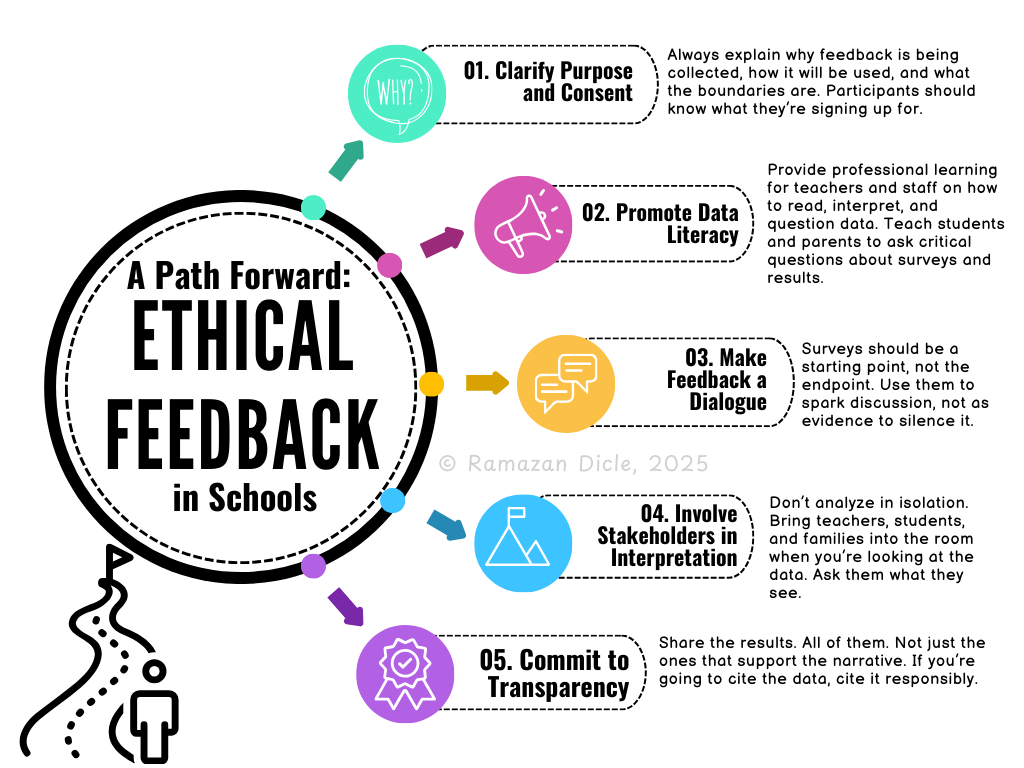
A Path Forward: Ethical Feedback in Schools
If we want feedback to rebuild trust rather than erode it, we must shift our approach:
- Clarify Purpose and Consent
Always explain why feedback is being collected, how it will be used, and what the boundaries are. Participants should know what they’re signing up for. - Promote Data Literacy
Provide professional learning for teachers and staff on how to read, interpret, and question data. Teach students and parents to ask critical questions about surveys and results. - Make Feedback a Dialogue
Surveys should be a starting point, not the endpoint. Use them to spark discussion, not as evidence to silence it. - Involve Stakeholders in Interpretation
Don’t analyze in isolation. Bring teachers, students, and families into the room when you’re looking at the data. Ask them what they see. - Commit to Transparency
Share the results. All of them. Not just the ones that support the narrative. If you’re going to cite the data, cite it responsibly.
Final Thoughts
In an age of data abundance, we need more than numbers—we need ethics. We need leaders willing to ask hard questions, and communities strong enough to have difficult conversations. Feedback is not a tool—it’s a relationship. If we use it with care, it has the power to transform our schools. If we misuse it, it will only deepen the divides.
Let’s choose transformation.
Works Cited
Muller, Jerry Z. The Tyranny of Metrics. Princeton University Press, 2018.
O’Neil, Cathy. Weapons of Math Destruction: How Big Data Increases Inequality and Threatens Democracy. Crown Publishing Group, 2016.
Smith, Alan. “Why We’re So Bad at Statistics.” TED, Apr. 2016, http://www.ted.com/talks/alan_smith_why_we_re_so_bad_at_statistics. Accessed 19 May 2025.
Arnstein, Sherry R. “A Ladder of Citizen Participation.” Journal of the American Institute of Planners, vol. 35, no. 4, 1969, pp. 216–224.
 Ramazan Dicle