My reflection on social media, adolescence, and the urgent need for emotional and algorithmic literacy
There was a time when a slogan was just a slogan.
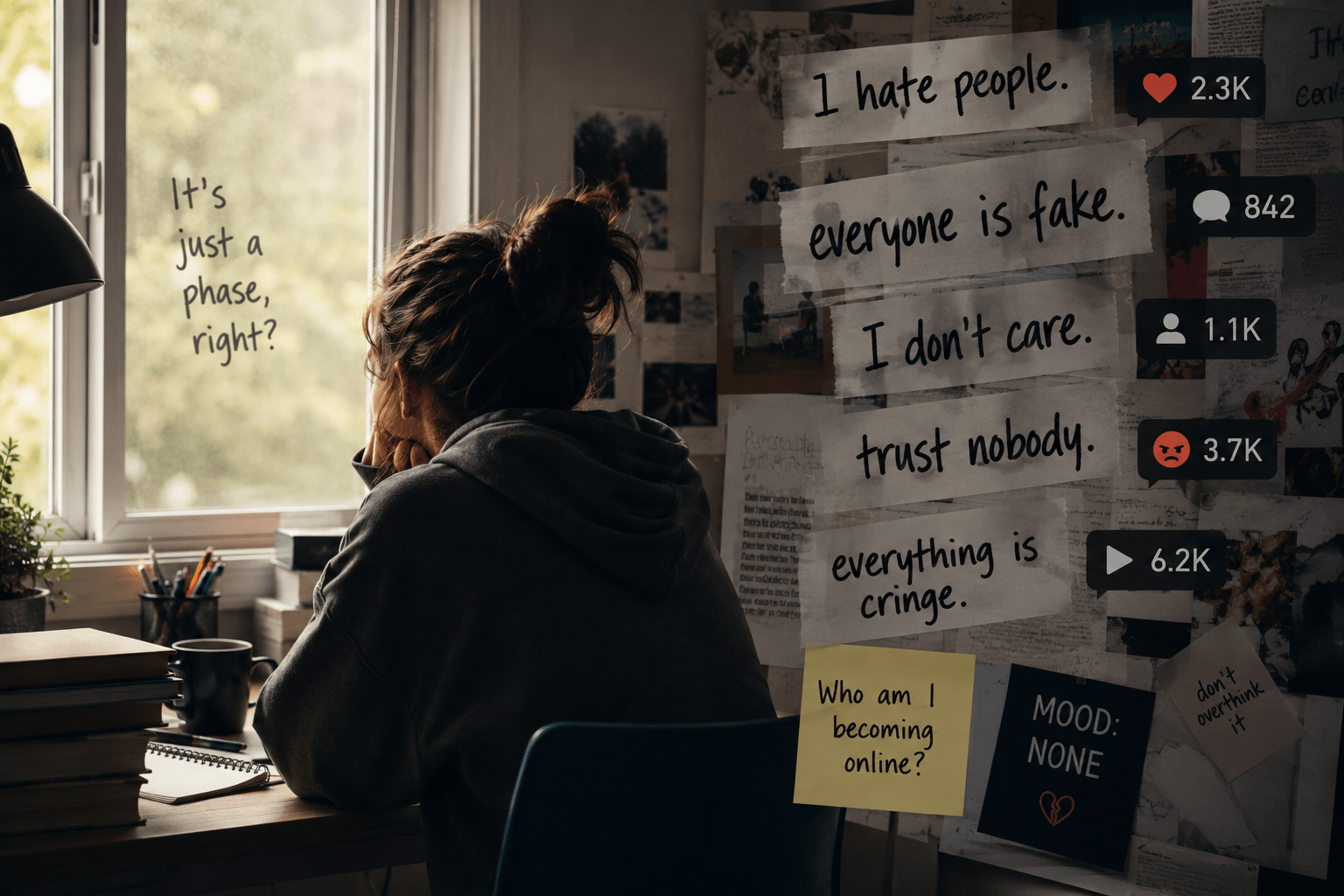
A sentence on a T-shirt, a phrase on a coffee mug, a joke shared among friends, or a sarcastic comment at the end of a long day could remain exactly that: a temporary expression of a mood. “I hate people.” “Everyone is fake.” “I do not care.” “Everything is cringe.” “Trust nobody.” “I am only happy when I am alone.” We have all heard versions of these phrases. Many of us have probably said something similar in moments of frustration, exhaustion, disappointment, or social overload.
The issue is not that young people sometimes feel cynical. They do. Adults do too. The issue is not that teenagers use irony, sarcasm, or dark humor. They always have, and these forms of expression can sometimes help young people process difficult feelings. The deeper concern is that these feelings are increasingly being packaged, repeated, aestheticized, monetized, and sold back to young people as identities.
This is where educators need to pay attention.
We are no longer dealing only with media that sells products. We are dealing with media that sells attitudes. It sells detachment as intelligence, contempt as confidence, apathy as maturity, and emotional distance as self-protection. It turns a passing feeling into a lifestyle. It takes pain, loneliness, disappointment, and distrust and converts them into shareable content, wearable merchandise, and online personas.
I have started thinking about this as a form of commodified misanthropy: the packaging and selling of distrust, contempt, emotional withdrawal, or dislike of people as a desirable identity. It is not simply that some people dislike others. It is that this dislike becomes marketable. It becomes cool. It becomes a way to signal that one is above the ordinary crowd, too intelligent to be fooled, too wounded to trust, or too morally pure to participate in the messiness of human relationships.
As educators, we should not respond to this with panic or moral superiority. Young people do not need adults to stand outside their culture and condemn it. They need adults who can help them read it. They need adults who can help them slow down, notice patterns, ask better questions, and distinguish between a feeling they are having and an identity they are being invited to adopt.
Today, digital literacy can no longer be limited to fake news, passwords, cyberbullying, or screen time. Those remain important, but they are not enough. Students need to understand how platforms shape attention, how algorithms reward emotional intensity, how identities are performed online, and how repeated exposure can create feelings before lived experience has had time to form them.
In other words, students need not only to read texts. They need to read influence.
From Advertising Products to Advertising Ways of Being
Traditional advertising often worked by creating desire for a product. A commercial showed a car, a drink, a pair of shoes, or a holiday destination. The message was clear: buy this, and your life will be better.
Modern digital culture often operates more subtly. It does not only sell products. It sells ways of being.
A hoodie does not simply keep you warm. It tells others what kind of person you are. A mug does not simply hold coffee. It announces your mood before you speak. A meme does not simply make you laugh. It invites you into a worldview. A short video does not simply entertain. It models a way of reacting to life.
This shift matters because adolescence is a period in which young people are actively forming identity. They are asking: Who am I? Where do I belong? What makes me different? What makes me worthy? What should I care about? What should I reject? Developmental psychology has long understood adolescence as a crucial period of identity formation, where young people negotiate belonging, self-definition, and social roles. Erik Erikson’s work on identity and adolescence remains foundational here, and later research continues to emphasize the relationship between adolescent identity development, peer relationships, and social context.
Social media enters this developmental stage with extraordinary force. It does not wait for students to have fully formed values, critical frameworks, or emotional maturity. It offers ready-made identities in seconds. The anxious perfectionist. The emotionally unavailable one. The “I hate people” introvert. The misunderstood genius. The exhausted overachiever. The one who sees through everyone. The one who has no faith in humanity.
Some of these identities may begin as humor. Some may begin as coping. Some may begin as genuine attempts to name difficult emotions. But when they are repeated endlessly and rewarded with likes, shares, comments, and belonging, they can begin to feel true.
This is why educators need to help students examine not only what content says, but what identity it offers.
A useful question for the classroom is:
What kind of person does this content invite me to become?
This question moves students beyond passive consumption. It invites them to notice the hidden curriculum of digital culture.
The Attention Economy Rewards Strong Feelings
The platforms young people use are not neutral public squares. They are businesses structured around attention. Their success depends on keeping people watching, scrolling, reacting, sharing, and returning.
This does not mean that every platform is intentionally trying to harm young people. It does mean that the system rewards whatever captures attention most effectively. Calm reflection is not usually the most profitable form of content. Nuance rarely spreads as quickly as outrage. Complexity does not always compete well with contempt.
Research on online moral-emotional language helps explain part of this dynamic. Brady and colleagues found that moral-emotional language increases the spread of content within social networks, describing this process as “moral contagion.” Crockett has also argued that digital media can transform moral outrage by increasing its frequency, visibility, and social rewards.
This matters in schools because students are not simply encountering information online. They are encountering information shaped by emotional incentives. Platforms often amplify what keeps users engaged, and highly charged emotional content can be especially effective at doing that.
A student may open an app for entertainment and leave with a reinforced belief about people, relationships, politics, school, gender, success, beauty, identity, or belonging. They may not experience this as learning, but learning is happening.
The algorithm becomes an invisible teacher.
It decides what is repeated.
It decides what appears normal.
It decides what deserves attention.
It decides which emotions are rehearsed daily.
Schools have formal curricula. Algorithms have informal curricula. The difference is that schools ideally design learning around human development, ethics, understanding, and growth. Algorithms are usually optimized for engagement.
If we do not help students examine this difference, they may mistake algorithmic repetition for truth.
Borrowed Emotions: Feeling Before Experiencing
One of the most concerning patterns I see is what I would call borrowed emotions.
Young people are exposed to intense emotional narratives before they have necessarily lived through the experiences that would naturally produce those emotions. A teenager who has not yet experienced a serious betrayal may still consume hundreds of videos saying “never trust anyone.” A student who is still learning how friendships work may repeatedly encounter content framing people as fake, toxic, or disposable. A young person who is having an ordinary bad day may be pulled into a feed that turns temporary sadness into a totalizing worldview.
This does not mean students are weak or easily manipulated. It means they are human. Humans learn socially. We absorb emotions, attitudes, and behaviors from others. Social learning theory has long argued that people learn through observation and modeling, not only through direct experience. In digital spaces, the scale and speed of this modeling is unprecedented.
This is especially important because adolescents are still developing the capacity to regulate emotion, evaluate risk, understand social complexity, and maintain perspective under peer pressure. The U.S. Surgeon General’s advisory on social media and youth mental health notes that social media can have both positive and negative effects, but also states that current evidence is not sufficient to conclude that social media is safe for children and adolescents. It highlights concerns around excessive use, sleep disruption, body image, social comparison, and exposure to harmful content. The American Psychological Association similarly recommends that adolescents should be supported in developing social media literacy and should be screened for problematic use when it interferes with daily routines and well-being.
The important word here is not “ban.” The important word is “support.”
Students need support because social media can be both helpful and harmful. It can connect isolated young people with communities of belonging. It can provide information, creativity, humor, activism, and identity affirmation. Common Sense Media and Hopelab’s 2024 report describes social media as a “double-edged sword,” noting that many young people use it for connection, emotional support, learning, decompression, and community, while also experiencing harms depending on content, context, and usage patterns.
This complexity matters. If educators only demonize social media, students may stop listening. They know it is not all bad. Many of them have found comfort, friendship, creativity, and representation online. Our task is not to deny that. Our task is to help them become more aware of what happens when comfort becomes dependency, when humor becomes identity, and when repeated exposure becomes worldview.
From Feeling to Identity
One of the most important distinctions we can teach students is the difference between a feeling and an identity.
Consider the difference between these statements:
“I feel overwhelmed by people today.”
“I hate people.”
“I felt left out.”
“Nobody is real.”
“I need quiet.”
“I am not made for people.”
“I was hurt.”
“You cannot trust anyone.”
The first set leaves room for movement. Feelings change. Circumstances change. Relationships change. The second set freezes the feeling into a conclusion. It turns a moment into a worldview.
This is not just a language issue. It is an identity issue.
When students repeatedly say “I am not a people person,” “I do not care,” “I hate everyone,” or “Everyone is cringe,” they may be joking. But repeated jokes can become rehearsed identities. Over time, a phrase can become a posture, and a posture can become a pattern of behavior.
Educators can help by modeling more flexible language.
Instead of saying:
“You are antisocial,”
we might say:
“You seem to need space today.”
Instead of saying:
“You do not care,”
we might say:
“I wonder whether caring feels too risky right now.”
Instead of saying:
“You are negative,”
we might ask:
“What has made this feel so disappointing?”
These shifts matter. They help students separate themselves from the emotion. They preserve the possibility of change.
A classroom that teaches emotional literacy gives students language for nuance. It helps them say, “I feel disconnected,” rather than “I hate everyone.” It helps them say, “I am disappointed,” rather than “people are trash.” It helps them say, “I need boundaries,” rather than “I trust nobody.”
This is not about policing language. It is about expanding it.
The Sanctimony of Cynicism
One reason cynicism spreads so easily is that it often feels intelligent.
To say “people are fake” can sound sharper than saying “relationships are complicated.” To say “everything is cringe” can sound more socially powerful than saying “I feel uncomfortable.” To say “I do not care” can feel safer than admitting “I care, but I am afraid of being disappointed.”
Cynicism gives immediate protection. It places the speaker above the situation. It allows one to judge without risking vulnerability.
This is why cynicism can become sanctimonious. It does not always present itself as sadness or fear. It often presents itself as superiority. “I see through people.” “I know how the world really works.” “I am not naive like everyone else.” “I am too honest to pretend.”
There is a difference between critical thinking and chronic contempt.
Critical thinking asks:
What is happening here?
What evidence do we have?
What assumptions are being made?
Who benefits?
What perspectives are missing?
Chronic contempt declares:
People are stupid.
Everyone is fake.
Nothing matters.
I already know what this is.
Critical thinking opens inquiry. Contempt closes it.
This distinction is essential in education. We want students to question, critique, analyze, and challenge. We do not want them to confuse dismissal with depth. A student who mocks everything is not necessarily thinking critically. Sometimes they are protecting themselves from the vulnerability of engagement.
Our role is to help students see that nuance is not weakness. Empathy is not naivety. Hope is not stupidity. Caring is not cringe.
The Algorithmic Classroom Outside School
Every educator knows that students do not only learn in school. They learn from family, friends, community, entertainment, public discourse, and now, increasingly, from algorithmically curated feeds.
The problem is that the algorithmic classroom has no teacher who knows the child. It has no pastoral care. It has no developmental understanding. It has no ethical responsibility in the way a school does. It does not ask whether a student has slept, eaten, moved, talked to a friend, or had a hard day. It does not know the student as a whole person. It knows patterns of engagement.
If a student watches content about loneliness, more loneliness may appear.
If a student watches content about distrust, more distrust may appear.
If a student watches content about humiliation, rage, or despair, more of that may appear.
From the student’s perspective, this can feel like recognition. “The app understands me.” “This is exactly how I feel.” “I am not alone.” And sometimes that is genuinely comforting. But there is a fine line between feeling seen and being kept inside a loop.
A student who feels lonely may need connection, rest, conversation, movement, creativity, or adult support. The feed may give them endless confirmation that loneliness is their permanent identity.
A student who feels angry may need justice, boundaries, reflection, repair, or advocacy. The feed may give them endless reasons to stay angry.
A student who feels socially anxious may need gradual confidence-building and safe relational practice. The feed may give them a community built around avoiding people.
This is why algorithmic literacy must become part of education. Students need to understand not only that algorithms recommend content, but that recommendations can shape emotional habits.
A powerful classroom question is:
If you watched ten videos with this message, what would your feed teach you tomorrow?
This question helps students see the feed as constructed, not natural.
Why “Just Ignore It” Does Not Work
Adults sometimes respond to youth culture with quick advice: “Just ignore it.” “Do not let it affect you.” “Spend less time online.” “It is not real life.”
These statements may contain some truth, but they are rarely enough.
For many students, online spaces are real social spaces. They are where friendships are maintained, jokes are shared, identities are tested, communities are found, and social status is negotiated. Saying “it is not real life” misunderstands how deeply digital culture is woven into adolescent experience.
At the same time, simply telling students to spend less time online does not teach them how to interpret what they encounter when they are online. Even students with healthy limits still need critical tools. A student can be online for twenty minutes and encounter emotionally powerful content. The question is not only how long they are online. It is what the content does to their thinking, emotions, and identity.
The goal, therefore, is not only restriction. It is interpretation.
Students need to learn to ask:
What is this trying to make me feel?
Why might that feeling be useful to the creator or platform?
What worldview is being repeated?
What identity is being offered?
Is this content helping me understand life more deeply, or is it making me more reactive?
How would I treat others if I believed this message every day?
How would I treat myself?
These questions are protective because they create distance between stimulus and response. They help students become observers of influence rather than only receivers of it.
From Visible Thinking to Visible Influence
As educators, we already have powerful tools for this work. Many of us use inquiry-based learning, visible thinking routines, concept-based teaching, media literacy, and reflective practice. These approaches can be adapted to help students analyze digital culture.
Project Zero’s Visible Thinking routines, for example, were designed to make thinking visible through structured questions and repeated patterns of reflection. Project Zero describes thinking routines as short sets of questions or steps that scaffold and support student thinking. The routine “Claim, Support, Question” encourages students to formulate interpretations, support them with evidence, and raise further questions.
These routines are extremely relevant to algorithmic culture.
When students encounter a meme saying “everyone is fake,” they can use Claim, Support, Question.
Claim:
What is this post claiming about people?
Support:
What evidence does it provide? Is that evidence strong, personal, exaggerated, or missing?
Question:
What questions should we ask before accepting this worldview?
Similarly, a routine like See–Think–Wonder can help students slow down before reacting.
See:
What do I actually notice in this post?
Think:
What do I think it is suggesting?
Wonder:
What am I curious about? What might be missing?
This matters because social media often collapses the space between seeing and reacting. Education can restore that space.
In this sense, we need to move from visible thinking to visible influence. Students should not only make their thinking visible. They should make the forces shaping their thinking visible.
A Guideline for Educators
The following framework is not a one-off lesson. It is a set of habits that can be integrated across advisory, language, humanities, arts, wellbeing, homeroom, digital citizenship, and interdisciplinary learning.
1. Start with curiosity, not condemnation
If we begin by saying, “This content is terrible,” students may defend it or disengage. Instead, begin with curiosity.
Ask:
Why do you think this is popular?
What makes this relatable?
What feeling does it capture?
Why might someone share this?
This approach does not approve of harmful messages. It simply opens a door. Students are more likely to think critically when they do not feel personally judged.
2. Separate the emotion from the message
Many cynical posts contain a real emotion. The message may be unhealthy, but the emotion underneath may be valid.
For example:
“People are fake” may contain disappointment.
“I hate everyone” may contain exhaustion.
“I do not care” may contain fear of caring.
“Everything is cringe” may contain insecurity or discomfort.
Ask students:
What feeling might be hiding underneath this statement?
Is there a healthier way to express that feeling?
What would this sound like if it were honest rather than performative?
This helps students develop emotional precision.
3. Teach the difference between critique and contempt
Students should learn to critique the world. They should question injustice, hypocrisy, manipulation, and harmful norms. But critique requires care, evidence, and responsibility. Contempt requires only dismissal.
Ask:
Is this content analyzing something or just mocking it?
Does it help us understand the issue better?
Does it invite action, reflection, or repair?
Or does it only invite superiority?
This distinction protects critical thinking from becoming cynicism.
4. Make algorithms discussable
Students should not experience algorithms as mysterious forces. They should be invited to examine them.
Ask:
Why do you think this appeared on your feed?
What might the platform think you are interested in?
What happens when you watch something all the way through?
What happens when you comment, pause, like, or share?
How can your behavior train your feed?
Students do not need to become computer scientists to understand algorithmic influence. They need enough awareness to recognize that their feed is not a mirror of reality. It is a prediction system shaped by engagement.
5. Analyze emotional hooks
Every piece of viral content has a hook. Sometimes it is humor. Sometimes outrage. Sometimes fear. Sometimes belonging. Sometimes moral superiority.
Ask:
What emotion catches our attention here?
What emotion keeps us watching?
What emotion might make us share it?
Who benefits if this emotion spreads?
This is especially important because emotional content can bypass careful thought. Naming the emotion restores agency.
6. Teach students to notice identity invitations
Every repeated message invites identification.
Ask:
What identity does this content offer?
Who is the “us” in this post?
Who is the “them”?
What kind of person is admired here?
What kind of person is mocked?
What would happen if someone performed this identity every day?
This is one of the most important questions educators can teach:
Is this who I want to become, or is this just what the platform wants me to keep watching?
7. Build language for temporary feelings
Students need sentence stems that help them avoid turning temporary emotions into permanent identities.
Instead of:
“I hate people,”
they might say:
“I feel socially exhausted today.”
Instead of:
“Nobody cares,”
they might say:
“I feel unseen right now.”
Instead of:
“I do not care,”
they might say:
“I care, but I feel overwhelmed.”
Instead of:
“Everyone is fake,”
they might say:
“I am finding it hard to trust people after what happened.”
This is not about forcing positivity. It is about giving students more accurate language.
8. Create low-stakes reflection rituals
Students need regular opportunities to reflect before they react.
A simple weekly advisory routine could ask:
What is one message you saw online this week that stayed with you?
What feeling did it create?
Did it help you?
Did it make you more hopeful, more anxious, more angry, more connected, or more isolated?
What do you want to do with that awareness?
The point is not surveillance. Students should not be forced to reveal private content. The point is to normalize reflection.
9. Reclaim empathy as intellectual strength
Empathy is often presented online as weakness, softness, or naivety. Schools must challenge this.
Empathy is not agreeing with everyone.
Empathy is not excusing harm.
Empathy is not avoiding critique.
Empathy is the ability to consider another perspective, understand context, ask better questions, and resist reducing people to caricatures. In diverse classrooms, empathy is not optional. It is part of learning how to live together.
Ask:
What might this person be experiencing?
What context might we not see?
How can we hold people accountable without dehumanizing them?
What changes when we become curious before we become contemptuous?
10. Model hopeful realism
Students do not need fake positivity. They know the world contains injustice, loneliness, pressure, cruelty, and disappointment. If adults pretend everything is fine, students will rightly reject that.
But students also do not need despair sold to them as sophistication.
Educators can model hopeful realism:
Yes, people can be disappointing.
And people can also change.
Yes, online spaces can be harmful.
And they can also be used with awareness.
Yes, systems can be unjust.
And thoughtful action still matters.
Yes, emotions can be intense.
And they do not have to become identities.
Hope is not the denial of difficulty. Hope is the refusal to let difficulty have the final word.
Classroom Applications
This work can be embedded naturally across the curriculum.
In language and literature, students can analyze tone, audience, purpose, and identity in digital texts. They can compare a poem about loneliness with a viral post about hating everyone. They can explore what language reveals and what it hides.
In individuals and societies, students can examine propaganda, consumer culture, social movements, polarization, and the economics of attention. They can ask how societies have always shaped identity, and what is different in algorithmic environments.
In the arts, students can analyze aesthetic trends: why sadness, detachment, nostalgia, or irony become visual styles. They can create counter-narratives that express difficult emotions without glorifying despair.
In advisory or wellbeing, students can reflect on emotional habits, social comparison, online boundaries, and the difference between solitude and isolation.
In interdisciplinary learning, students can investigate the relationship between technology, psychology, economics, and ethics.
This is not an extra topic. It is connected to everything we already teach: identity, communication, power, systems, perspective, wellbeing, and responsibility.
A Sample Inquiry Sequence
Educators could structure a short unit or advisory sequence around the question:
How do online messages shape the way we see ourselves and others?
Lesson 1: Noticing the Pattern
Students collect or are provided with anonymized examples of common online slogans:
“Trust nobody.”
“Everyone is fake.”
“I hate people.”
“Nothing matters.”
“Being nice is embarrassing.”
“People are exhausting.”
They sort them into categories:
Humor
Pain
Identity
Superiority
Boundary-setting
Hopelessness
Social critique
Then they discuss:
Which ones feel harmless?
Which ones could become harmful if repeated daily?
What makes the difference?
Lesson 2: Feeling or Identity?
Students rewrite fixed identity statements into temporary feeling statements.
“I hate people” becomes “I feel socially drained.”
“Everyone is fake” becomes “I have had experiences that made trust difficult.”
“I do not care” becomes “I feel overwhelmed and need space before I can respond.”
Students discuss how language changes possibility.
Lesson 3: The Algorithmic Mirror
Students explore how recommendation systems work in simple terms. They discuss how watching, pausing, liking, sharing, and commenting can shape future content.
Prompt:
If someone watches videos about distrust every night for a week, what might they begin to believe?
The aim is not fear. The aim is awareness.
Lesson 4: Claim, Support, Question
Using a selected post or slogan, students apply Claim, Support, Question.
Claim:
What is the message claiming?
Support:
What evidence does it use?
Question:
What should we ask before believing it?
This turns a slogan into an object of inquiry.
Lesson 5: Counter-Narratives
Students create alternative messages that acknowledge difficult feelings without turning them into contempt.
For example:
Instead of “I hate people,”
“I need quiet, but I still need connection.”
Instead of “Trust nobody,”
“Trust carefully, but do not stop trusting completely.”
Instead of “Everyone is cringe,”
“Discomfort is not always danger.”
This is not forced positivity. It is linguistic repair.
What Protection Really Means
When we talk about protecting young people, we often imagine blocking, banning, filtering, or limiting. These may sometimes be necessary, especially for younger children or harmful content. But protection cannot only be external.
The deeper form of protection is internal capacity.
A protected student is not one who never encounters harmful ideas. That is impossible.
A protected student is one who can pause.
One who can name the emotional hook.
One who can ask who benefits.
One who can distinguish evidence from performance.
One who can separate feeling from identity.
One who can seek help when content becomes overwhelming.
One who can recognize that not every thought deserves to become a worldview.
This kind of protection is built slowly, through repeated conversations, reflective routines, trusting relationships, and adult modeling.
The Educator’s Responsibility
We cannot control every message students encounter. We cannot compete with the speed, design, and emotional intensity of social media. We cannot stand at the entrance of every algorithmic tunnel and stop students from entering.
But we can do something powerful.
We can teach students to carry a light with them.
We can help them notice when contempt is being sold as confidence.
We can help them notice when despair is being dressed up as intelligence.
We can help them notice when loneliness is being converted into identity.
We can help them notice when their emotions are being harvested for engagement.
We can help them notice when a platform is not simply showing them what they like, but shaping what they expect from the world.
Most importantly, we can offer an alternative experience.
In classrooms, students can experience dialogue instead of performance.
Complexity instead of slogans.
Curiosity instead of contempt.
Repair instead of cancellation.
Belonging instead of branding.
Hope instead of fashionable despair.
This does not mean schools should become sentimental spaces where every difficult emotion is softened. On the contrary, schools should be places where difficult emotions can be taken seriously. But taking them seriously means helping students understand them, not turning them into marketable identities.
Conclusion: Teaching Students to Read What Is Trying to Shape Them
The central educational question of our time may not be only “What do students need to know?”
It may also be:
What is trying to shape how students know, feel, relate, and become?
Our students are growing up in environments where attention is monetized, emotion is amplified, and identity is constantly performed. They are surrounded by messages that do not simply ask them to buy something, but to become someone: more detached, more suspicious, more ironic, more outraged, more hopeless, more superior, less vulnerable.
As educators, we should not respond with fear. We should respond with pedagogy.
We need to teach students to read digital culture with the same seriousness with which we teach them to read literature, history, science, art, and society. We need to help them ask not only whether a message is true, but what it does. What does it do to my attention? What does it do to my mood? What does it do to my relationships? What does it do to my sense of self? What does it make easier to feel? What does it make harder to imagine?
Young people deserve more than cynicism marketed as maturity. They deserve language for complexity. They deserve adults who take their digital lives seriously without reducing them to victims. They deserve classrooms where empathy is practiced as a strength, where critique does not collapse into contempt, and where hope is modeled as a disciplined way of engaging with the world.
The aim is not to produce students who are blindly optimistic.
The aim is to nurture students who are awake.
Awake to influence.
Awake to emotion.
Awake to algorithms.
Awake to identity.
Awake to their own agency.
Because the most powerful form of digital literacy is not simply knowing how to use technology.
It is knowing when technology is quietly trying to use us.
And the most powerful form of education is not simply preparing students to survive the world as it is.
It is helping them imagine, question, and build the world as it could be.
Works Cited
American Psychological Association. “Health Advisory on Social Media Use in Adolescence.” American Psychological Association, 2023.
Bandura, Albert. Social Learning Theory. Prentice Hall, 1977.
Brady, William J., Julian A. Wills, John T. Jost, Joshua A. Tucker, and Jay J. Van Bavel. “Emotion Shapes the Diffusion of Moralized Content in Social Networks.” Proceedings of the National Academy of Sciences, vol. 114, no. 28, 2017, pp. 7313–7318.
Common Sense Media and Hopelab. A Double-Edged Sword: How Diverse Communities of Young People Think About the Multifaceted Relationship Between Social Media and Mental Health. 2024.
Crockett, Molly J. “Moral Outrage in the Digital Age.” Nature Human Behaviour, vol. 1, 2017, pp. 769–771.
Erikson, Erik H. Identity: Youth and Crisis. W. W. Norton, 1968.
Project Zero, Harvard Graduate School of Education. “PZ Thinking Routines.”
Project Zero, Harvard Graduate School of Education. “Claim, Support, Question.”
Ragelienė, Tija. “Links of Adolescents Identity Development and Relationship with Peers: A Systematic Literature Review.” Journal of the Canadian Academy of Child and Adolescent Psychiatry, vol. 25, no. 2, 2016, pp. 97–105.
U.S. Surgeon General. Social Media and Youth Mental Health: The U.S. Surgeon General’s Advisory. U.S. Department of Health and Human Services, 2023.